

Brandenburger Tor - Berlin
Berlin, marked by the Brandenburger Tor, is where YT’s early connection to Germany took root and his aspiration for its education system first began.
For YT, returning to Germany was less an exploration and more a long-delayed homecoming. His connection with Germany began in childhood, his mother once worked in Berlin, and after finishing junior high school, he took a gap year to study in a local school there. That year not only familiarized him with daily life in Germany but also planted a lingering thought in his mind: “One day, I’ll come back.” Back then, he was convinced that this early experience would make reintegrating into Germany effortless in the future.
His family environment also nudged him toward an international path. His parents and older brother had all studied abroad, making overseas education an almost natural expectation at home. Yet despite his Berlin background, he did not continue studying German during high school, resulting in an unsatisfactory language-exam score.
This led him to recognize another pathway: many top German master’s programs offer fully English-taught curricula. Therefore, after completing his bachelor’s degree in Finance at National Chengchi University, he applied to the University of Mannheim’s Master in Management program, officially embarking on what he believed would be a smooth return to Germany.
During the application process, TaiGer also helped him clarify the requirements and timeline for English-taught programs, making his overall planning more strategic.
Inside the German Academic System: One Final Exam Determines Everything
After arriving in Mannheim, YT quickly realized that the Germany he remembered from Berlin differed greatly from the Germany he was experiencing now.
The most striking difference came from the academic system. Although classroom interaction felt somewhat similar, the structure of German courses was far more condensed and intense.
Most modules rely entirely on a single final exam to determine the entire semester grade. No midterms, no weekly assignments—just a standard one-shot-decides-all. This high-pressure format requires sustained focus throughout the semester; any slip may affect the outcome.
The class pace also exceeded his expectations. Professors commonly go through 30–40 slides per session, assuming students already possess the required foundational knowledge without spending extra time on background explanations. This forced him to invest more hours after class to fill in theoretical gaps and research supporting materials just to keep up.
However, he also observed that a strict system doesn’t mean students behave like machines. There are still students who skip classes, cram last-minute, or only start studying seriously near the end of the term. These details helped him understand that strict structures and individual study rhythms coexist in German academic culture.
Adjusting to Daily Life: From Familiar Berlin to the New Rhythm of Mannheim
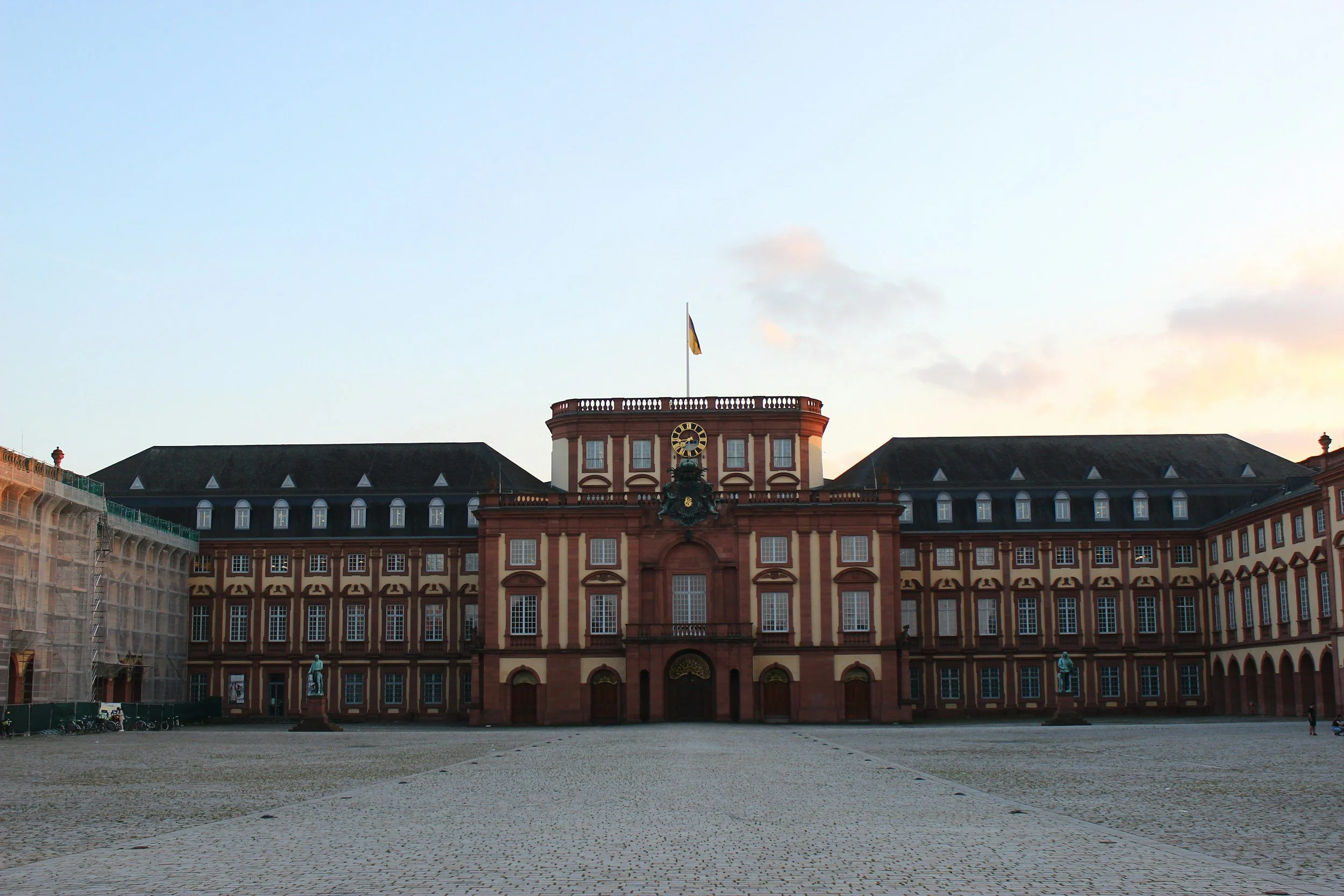
University of Mannheim
The University of Mannheim stands as one of Europe’s premier business universities - renowned for shaping globally recognized professionals and uniquely housed within a breathtaking Baroque palace.
Beyond academics, daily life brought its own changes. He was assigned to a residence on the city’s edge, where the living environment was culturally diverse—initially unfamiliar, but increasingly interesting over time. He eventually came to appreciate this multicultural blend: hearing different languages, observing cultural nuances, and absorbing the city’s rhythms as part of everyday life.
What surprised him even more was the composition of an English-taught program. He initially imagined an international cohort from many countries, but nearly 80% of students were German locals, mainly because the program’s structure was shared across several master’s specializations, naturally making it German-dominant.
This shaped both classroom interaction and social life:
In class, communication was smooth.
Outside class, integrating into social circles required extra initiative.
YT admitted that he initially felt a mild sense of distance, but with time, he learned to adjust his mindset, seeing these differences as cultural norms rather than barriers. He also discovered that bonding with other international students often formed a stronger support network, helping each other academically, socially, and linguistically. This community eventually became one of his greatest sources of stability in Germany.
A New Chapter in Language and Connection: From German Tandem Plans to Korean Lessons
To make language learning and social interaction more meaningful, YT joined the school’s Asia-Pacific Management Club, hoping to find a German student for a tandem partnership, exchanging German for Chinese.
However, he soon realized the imbalance: there were far more international students wanting to learn German than German students wanting to learn Chinese. Although the tandem match didn’t work out, a new opportunity emerged unexpectedly. A Korean student fascinated by Chinese culture approached him, suggesting a Chinese–Korean language exchange. And just like that, YT began an unforeseen Korean-learning journey in Germany.
He joked that the experience felt backwards, but he also realized that such cross-cultural interactions added joy to daily life and even became an international experience he could put on his CV, showcasing adaptability and linguistic flexibility.
Conclusion: Real Growth Is Learning to Adjust in Uncertainty
YT’s study journey in Germany is not merely an extension of childhood memories; it is a practice in maturity and adaptation.
He learned to accept expectation gaps as an inherent part of studying abroad and found his own pace amidst moments that didn’t go as imagined. Academic pressure, lifestyle adjustments, and cultural differences all became nutrients for developing independence, self-management, and resilience.
And ultimately, he realized: the value of studying abroad lies not only in earning a degree, but in learning how to keep moving forward in an ever-changing environment.
No one’s study-abroad journey goes exactly as imagined — but with the right guidance, it becomes a path of growth and opportunity. Contact us today and let TaiGer support you in building a clear, confident, and successful path to studying in Germany!
